This variety is reputed to be the second most important in China, after the more famous Long Jin tea from West Lake (Hangzhou – Zhejiang).
It is a very delicate tea with a rolled shape, characterized by the presence of white buds that give it that typical slightly fluffy appearance.
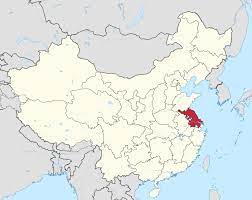
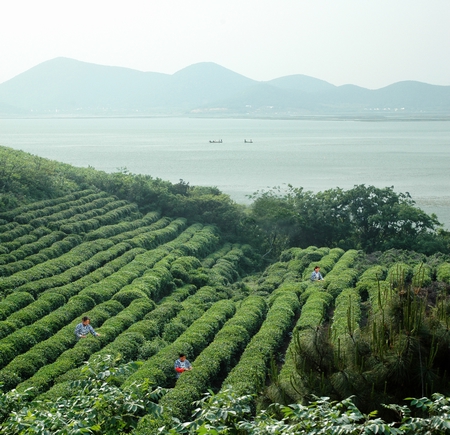
It is produced today, just as it once was, on the mountain slopes of the Dongting region near Tai Lake in the beautiful city of Suzhou, in the Wu Xian district of Jiangsu (you can see the location of Jiangsu within the Chinese State in the photo below. ).
Like most Chinese green teas, after harvesting it is passed to the wok for killing the green (shaqing), then gently rolled to give it the characteristic spiral shape. It is finally dried.
You know that almost all Chinese teas are linked to moral or poetic legends. In this case the legend could not be missing but perhaps it is not so …. poetic!
It is said that once the harvest of this tea was so flourishing that the gatherers, exhausted their baskets, begin to fill clothes and body with tea. The leaves, in contact with the body heat, began to produce an intense odor, compared by some to a sort of incense aroma.
When they realized this they began to call this tea 嚇 煞人 香 (xià shà rén xiāng) or “scary fragrance”.
One day the Kangxi Emperor visited the lake and tasted the tea. He was very surprised by the name that had been given to this noble and delicate tea so he decided to change its name to the current one, Bi Luo Chun which means “spring jade snail” (due to the color and shape).
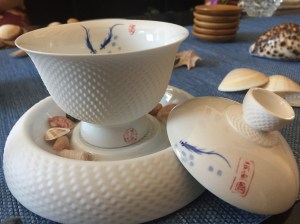
texture similar to a fishing net,
small fishes and shells.
Now I am going to illustrate the preparation method which is, as you can imagine, my favorite part!
First method called “Shangtou“
Heat the water to about 65 ° / 70 ° without boiling it.
(Needless to say, it has to be mineral water. For my students of Tea Sommelier courses I suggest: “Try to have fun experimenting with different types of water. Santa Anna goes well with almost anything but here you may want to experiment with water content lower sodium. High sodium gives grit to “important” and intense teas that already have a tendency to salinity and umami, while with very delicate teas you need a lower quantity of sodium. Be careful though: very low quantities of sodium could turn off the tea “).

Preheat a medium-sized gaiwan and all other utensils (porcelain or glass are materials that can work very well for this type of tea, but glass is preferable as you can see the classic “leaf dance”).
Some prefer to use large jugs or bowls to make this type of brew. The shape doesn’t really matter.
Add water back into the gaiwan and fill it to 70% full.
Gently pour the tea into the water without turning or “sinking” it, but waiting for it to go down by itself.
The amount of tea I recommend to use is about 5 grams (considering a ratio of 1:25), of course if you have a gaiwan or other type of infuser with a capacity greater than 150 ml you can add a little more tea.
The waiting time will be slightly longer as the leaves placed on top of the water will take a little longer to rehydrate.
I usually wait 30 seconds for the first infusion. And about 25 seconds for the second. The number of infusions depends on the strength of the tea: with a high quality tea you will surely make three infusions and you could reach four in some cases.

Second method called “Zhongtou“
Heat the water to about 65 ° / 70 ° without boiling it.
Preheat a medium-sized gaiwan and all the other utensils or a tall glass of the type used to make Long Jin.
Add water back into the gaiwan and fill it to 25%.
Gently pour the tea into the water, wait a couple of seconds and fill the rest of the gaiwan with water.
Wait 20 seconds and strain (or drink).

Some people prepare this tea with the classic method of the glass (“Xiatou”) used for Long Jin, but I find that pouring hot water directly on the leaves and making them dance immediately in the glass is too aggressive for Bi Luo Chun.
The high quality Bi Luo Chun I tasted recently has delicately curled, fluffy leaves with lots of white buds.
Wet leaves remind
The infusion has a very light color tending to
On the palate it appears that it is

I hope that my reflections will invite you to experiment, taste and broaden your borders in the world of tea!
I hope my reflections invite you to experiment, taste and broaden your borders in the world of tea!
Are you interested in learning more about the world of tea?
You can attend one of our Tea Sommelier courses.
The courses are divided into four levels. First and second levels last nine hours divided into three days. It is possible to choose whether to attend on weekdays or weekends.
The course can be attended in person at the Jaku School in Lucca (in Tuscany) or in online version with teacher.
Those who choose the online version will connect via Skype videoconference and the teas, sent home, will be prepared live step by step.
Do you want more information? You will find them here:

 The art of tea blog / Blog l'arte del tè